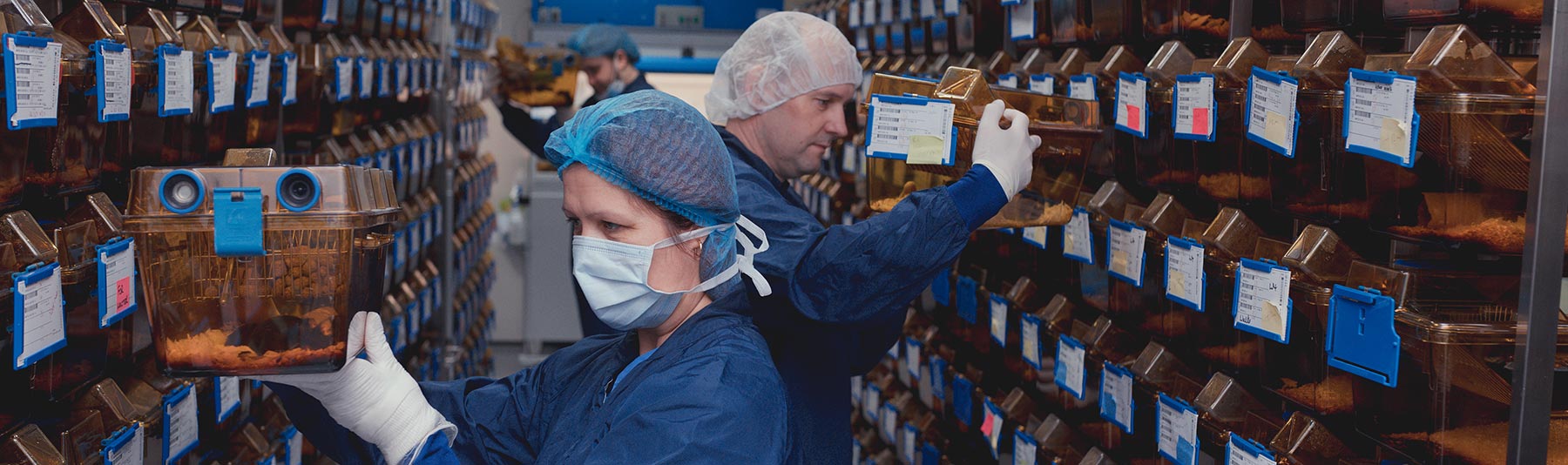
Development and use of genetically altered models for medical research
With tutor Michelle Stewart PhD
This unit provides attendees with all the information they need to be able to plan effective breeding programmes with genetically altered mice.
Face to Face learning – 15th and 16th March 2027 at the Advance Training Centre. Additional online sessions will be arranged nearer the time.
You will cover
- Development of genetically altered mouse models
- Breeding and maintaining genetically altered mouse strains
- Calculating breeding numbers
- Interpreting genotyping results
- History of the mouse in genetic research
Key Skills you will develop
- Understanding of how genetically altered mouse models have been developed
- Ability to plan breeding programmes to maintain a genetic alteration within a population
- Understanding of the difference between backcrossing and intercrossing and their purpose within a breeding scheme
- Ability to determine the number of animals required to breed specific experimental cohorts
- Ability to recognise different inheritance patterns and explain their biological origins
- Ability to evaluate the use and selection of different inbred strains
- Ability to interpret genotyping results and troubleshoot genotyping errors
- Ability to calculate the frequency of different genotypes in single, double, and multiple allele crosses
- Ability to plan appropriate genetic controls for experiments involving genetically altered animals
- Ability to explain advantages and disadvantages of the use of mice in scientific research
Occasionally it is necessary for courses to be cancelled or rescheduled by CLAST. The Course Administrator will send an email to advise you of the cancellation and, if possible, provide a new date for the course. We will endeavour to give at least 4 weeks’ notice prior to the course start date.
Course Details
- Diploma Credits: 20
- Unit Number: U5.14
- Tutor: Michelle Stewart
For CPD students, 45 credits are available from the IAT






Unable to access higher education because of financial reasons?
Please note that if your finances are tight, you can also apply for funding to help cover costs associated with course attendance from organisations such as Animals in Science Education Trust (AS-ET), Laboratory Animals Limited, Laboratory Animal Science Association (LASA) , and Universities Federation for Animal Welfare (UFAW) and are encouraged to explore other opportunities for sourcing financial assistance to help cover training costs.